How to Find Low Competition Keywords: 5 Steps to Easy Wins
By seodada · Published
Overview
To find low competition keywords, you look for search terms that are easier to rank for but still get real traffic. This guide covers five practical steps: expand your keyword ideas, check difficulty, volume, and intent, pull gaps from competitors, filter the list, and avoid common mistakes. Each step helps you pick terms you can actually win.
Low competition keywords are terms where the pages on page one are not very strong. Those are the targets worth your time. They are not a shortcut to traffic, but they give a new or small site a realistic place to start. Use the steps below to build a short, winnable list.
What are low competition keywords and why target them?
Low competition keywords are search terms that few strong pages compete for. Because the top results are weak or thin, a new page has a fair chance to reach page one. That makes them a practical place to start.
There are three main reasons to target them. First, they give you easier wins so you see results sooner. Second, they bring in visitors who searched for a specific need, which often means a better fit. Third, a steady run of small wins builds topical authority over time. This helps your larger pages later.
To judge how winnable a term is, look at keyword difficulty. seodada's Keyword Research Tool estimates how hard it is to rank on page one, based on the strength of the pages already there. Treat it as a guide, not a fixed score.
Step 1: Start with broad ideas and expand your keyword universe
Start with a few seed keywords that describe your business or topic. Keep them general. Think about the problems your customers have and the words they would type to solve them.
Next, expand each seed into a much larger list. The Keyword Research Tool takes one seed and returns related, long-tail and competitor-derived ideas, each with monthly search volume and competition. Long-tail phrases often carry less competition than broad terms.
Great keyword research is not a list of high-volume terms. It is knowing which searches your site can realistically win. A lower-volume term you can rank for may be more valuable than a high-volume one you cannot.
Building a wide list without losing focus
Collect everything first, then clean up later. Do not judge ideas while you gather them. Group similar phrases together, such as "keyword tool for beginners" and "beginner keyword tool," so you can see how many variations sit around one topic.
Step 2: Analyze keyword difficulty, volume, and intent
Once you have a list, check three things for each term: search volume, difficulty, and intent. Together they show if a keyword is worth the effort.
Pair volume with difficulty. A lower-volume term you can win and that matches your page beats a large term you cannot.
Matching search intent to your page type
Search intent is what the searcher wants. Match your page type to it. Informational queries suit a guide. Commercial queries suit a comparison, and transactional queries suit a product or service page. A mismatch rarely ranks, even when the keyword looks easy. If the top results are all guides, and you plan a sales page, move on.
The Keyword Research Tool shows if a query is informational, commercial, or transactional. Check it before you write anything.
Step 3: Find high-value, missing keywords from your competitors
A gap list is the most useful list you can build. It shows keywords your competitors rank for and you do not. These are terms with proven demand that you are missing.
Use the Competitor Keyword Gap Analysis Tool. Enter your domain and a few rivals. The tool splits its keywords into three groups: terms you both rank for, terms only they rank for, and terms only you rank for. The second group is your gap list.
Compare against several rivals at once. Gaps that appear across your whole market are often safer bets than a term only one rival ranks for. For a deeper walkthrough, see How to Analyze Competitor Keywords for Better Ranking.
Step 4: Filter and prioritize your low competition keyword list
Difficulty alone does not decide a keyword's value. Filter your list by hand. Is the term relevant to your audience? Does it support your goals? Do you already have content that could cover it? Would a visitor who finds it likely act on your page?
Next, consider your site's strength. A domain with little authority will struggle on terms that bigger sites dominate, even when the difficulty score looks moderate. The Domain Analysis tool gives an authority score for any domain, so you can see if you are punching up or down. Treat the score as a comparison and trend measure, not an exact figure.
Sort your spreadsheet by a mix of difficulty, relevance, and intent. Keywords that score well on all three are your best starting points.
Common mistakes to avoid when finding low competition keywords
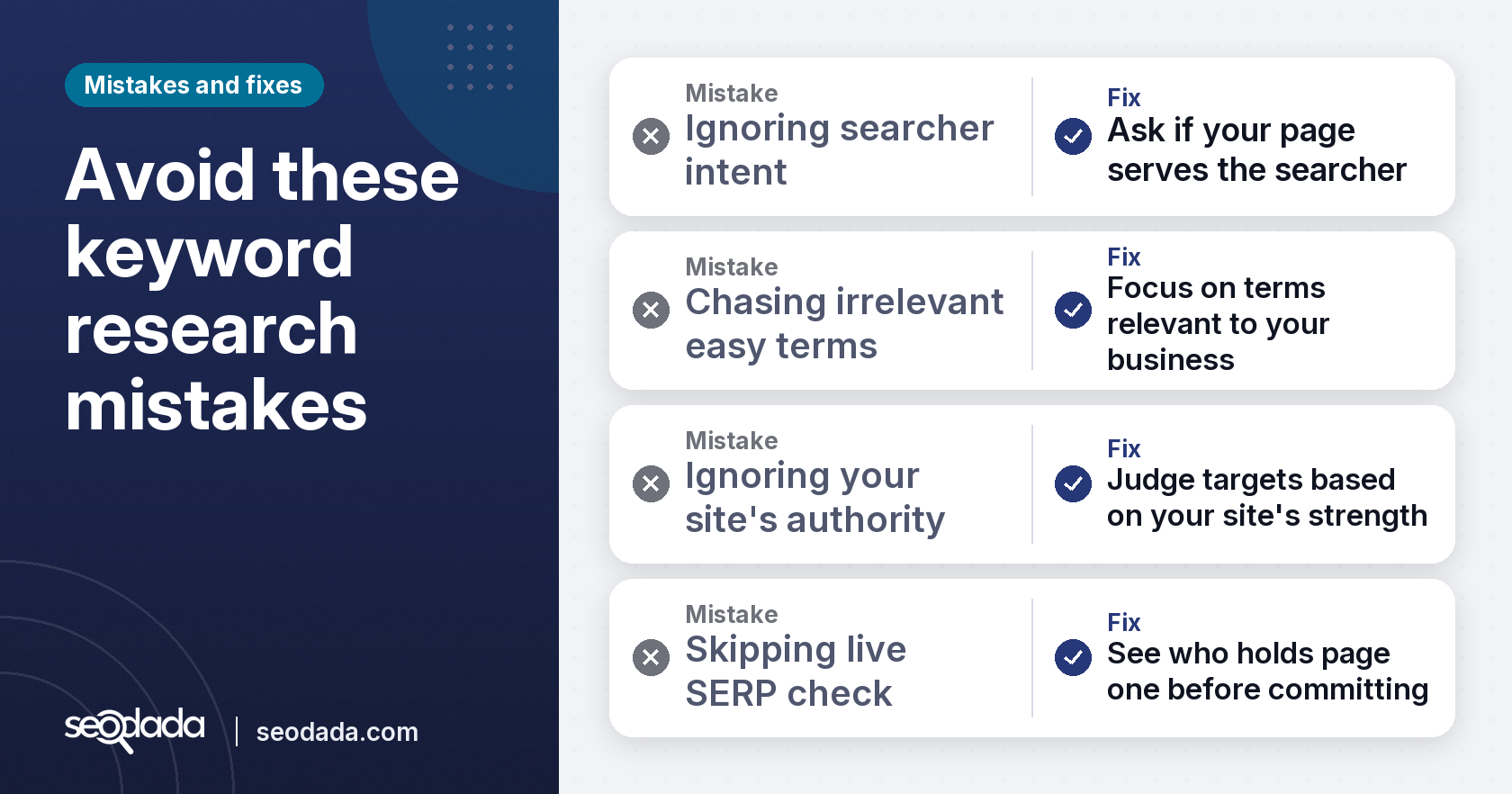
Most failed keyword plans make the same few errors. Avoid these:
- Looking only at keyword difficulty and ignoring intent.
- Chasing terms with no relevance to your business, just because they look easy.
- Ignoring your own site's authority when judging a target.
- Skipping a check of the live results page. Open the SERP Ranking view and see who holds page one before committing.
- Skipping competitor analysis and building the list from guesses alone.
Tools give you numbers, but the final judgment is yours. Read the results, ask if your page would serve the searcher, and only then commit.
Key takeaways
- Low competition keywords are terms with weak competing pages, so they offer easier ranking chances.
- Expand a few seed keywords into a wide list, then judge each term on volume, difficulty, and intent.
- A competitor gap list shows proven demand you are currently missing.
- Filter by relevance, business goals, and your site's authority before you commit.
- Avoid chasing numbers alone, and always check intent and the live results page.
Conclusion
Finding low competition keywords comes down to a simple process. Expand your ideas and check difficulty, volume, and intent together. Pull gaps from competitors, then filter the list against your goals and authority. Repeat this regularly. Start with your first seed keyword today.
FAQs
What are low competition keywords?
They are search terms where the pages ranking on page one are relatively weak or few. Because the competition is lighter, a new page has a better chance to rank and draw traffic.
What is the 80/20 rule in SEO?
A small share of your keywords or pages often brings most of your traffic. Focus your effort on the terms and pages that already perform well, then build from there.
How to find out competitors' keywords?
Use a gap analysis tool. Enter your domain and a few rivals, then review the terms only they rank for. A domain analysis view also lists the keywords any single domain ranks for.
Which niche has the lowest competition?
No niche is uniformly low competition. Competition depends on the specific term and location, so check difficulty for each keyword rather than relying on a whole niche.
Can I find low competition keywords for free?
Some tools offer limited free checks. Start with a few seed keywords, review difficulty and intent, and compare a small number of rivals to build an early list.
How often should I update my keyword list?
Review it every few months, or sooner if your market changes. Rankings and search demand shift, so a term that was easy last year may now be harder to win.
Frequently asked questions
What are low competition keywords?
They are search terms where the pages ranking on page one are relatively weak or few. Because the competition is lighter, a new page has a better chance to rank and draw traffic.
What is the 80/20 rule in SEO?
A small share of your keywords or pages often brings most of your traffic. Focus your effort on the terms and pages that already perform well, then build from there.
How to find out competitors' keywords?
Use a gap analysis tool. Enter your domain and a few rivals, then review the terms only they rank for. A domain analysis view also lists the keywords any single domain ranks for.
Which niche has the lowest competition?
No niche is uniformly low competition. Competition depends on the specific term and location, so check difficulty for each keyword rather than relying on a whole niche.
Can I find low competition keywords for free?
Some tools offer limited free checks. Start with a few seed keywords, review difficulty and intent, and compare a small number of rivals to build an early list.
How often should I update my keyword list?
Review it every few months, or sooner if your market changes. Rankings and search demand shift, so a term that was easy last year may now be harder to win. Related: SERP Checker: Live Google Results by Location