
If you want your content to stay clear and easy for search engines to understand, you need to focus on Heading Tag Optimization. Headings help both users and search engines follow your content from top to bottom. In 2025, a clean structure matters even more because search engines rely heavily on meaning, clarity, and context.
In this guide, you will learn why heading tags still matter, how to structure them correctly, and how to optimise each level the right way.
Why Heading Tag Optimization Still Matters in 2025
Headings are one of the simplest ways to show structure. When your headings follow a clean order, search engines understand your content faster. Strong headings also help users scan your page and stay engaged longer.
A clean structure supports your h tags, improves readability, and helps search engines connect your content with the right searches.
The Ideal Heading Hierarchy for 2025
Heading hierarchy is the order of your H1, H2, H3, and other levels. When done right, it creates a clear path for readers and search engines. You can see this when looking at h1 h2 h3 examples, where each level adds meaning without breaking the flow.
A strong 2025 structure looks like:
- H1: Page title
- H2: Key sections
- H3: Supporting details
- H4: Extra depth when needed
This follows the natural order of h1 to h6 and keeps your layout simple and strong.
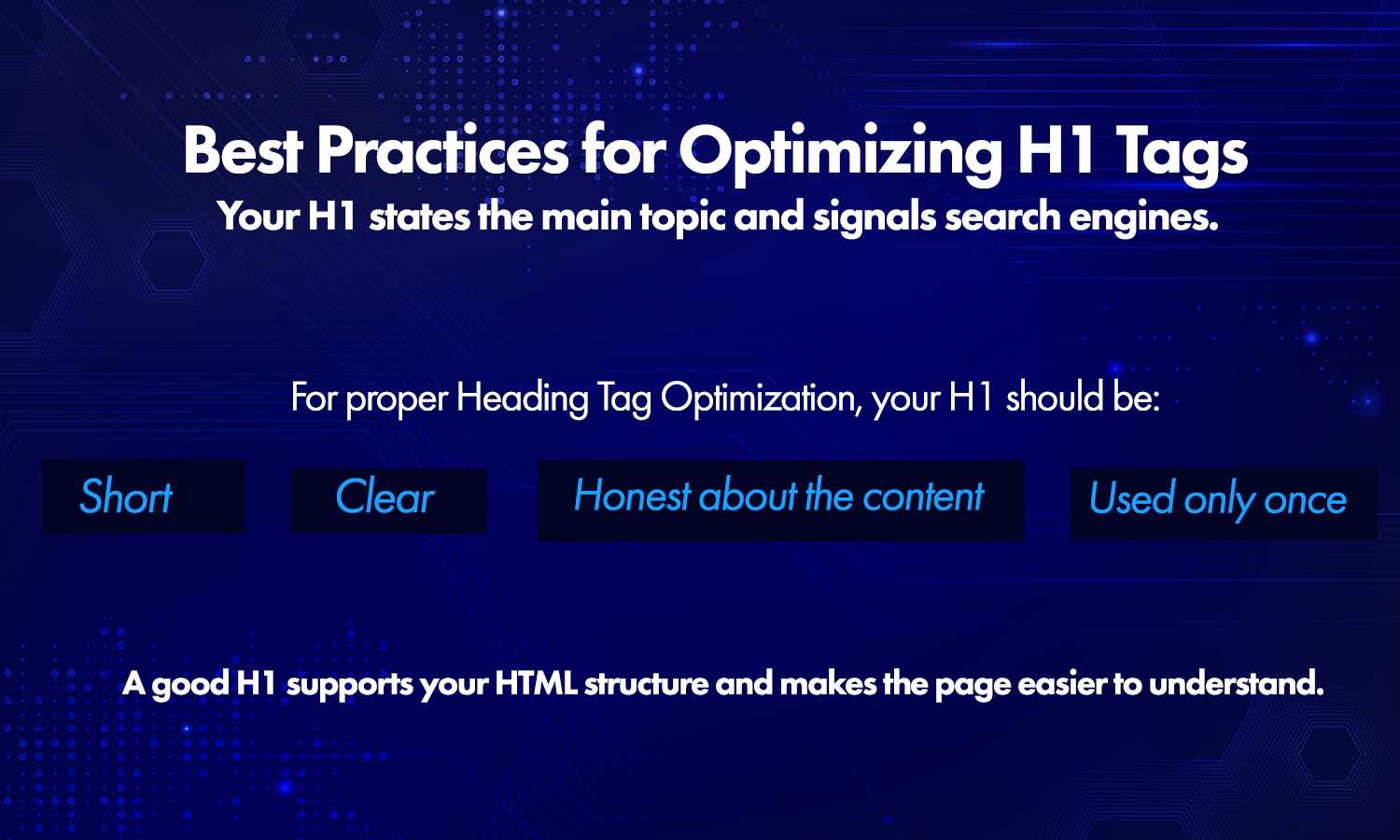
Best Practices for Optimizing H1 Tags
Your H1 is the most important heading on the page. It introduces your main topic clearly and gives search engines the right signals.
For proper Heading Tag Optimization, your H1 should be:
- Short
- Clear
- Honest about the content
- Used only once
A well-written H1 header also supports your H1 HTML tag structure and makes your page easier to understand.
If you look at h1, h2, h3 h4 h5 h6 sizes, you will see that the H1 is usually the largest. But the meaning behind the tag is more important than the size.
Best Practices for Optimizing H2 Tags
Your H2 tags hold your major sections. They guide your users through your key ideas. Good H2s should be specific and match the content that follows.
H2 tags also support your H1, H2 H3 HTML order. When structured well, they improve the meaning of your content. You can check your sections easily by reviewing your header tag in HTML or using tools that show your heading layout.
Best Practices for Optimizing H3 & H4 Tags
H3 and H4 headings offer a deeper explanation. They help break long sections into readable parts. When used naturally, they make your content easier to process.
These tags support your HTML H tags and help you create a clear outline throughout your page. If you need an example, you can look at a heading tag in HTML with an example to understand how smaller headings support larger ideas.
Most websites do not need H5 or H6 often, but they are still part of the full HTML heading system.
How AI & Voice Search Are Changing Heading Optimization
AI tools and voice search read your content differently than humans. They rely on clear sections, simple wording, and strong structure. A clean HTML5 header tag makes your content easier to scan by search engines.
Tools like SEO Dada help you see your entire heading layout quickly and make changes to keep your structure clear. This helps you optimise your meta heading and ensure each tag supports meaning and clarity.
As AI grows, structure becomes even more important.
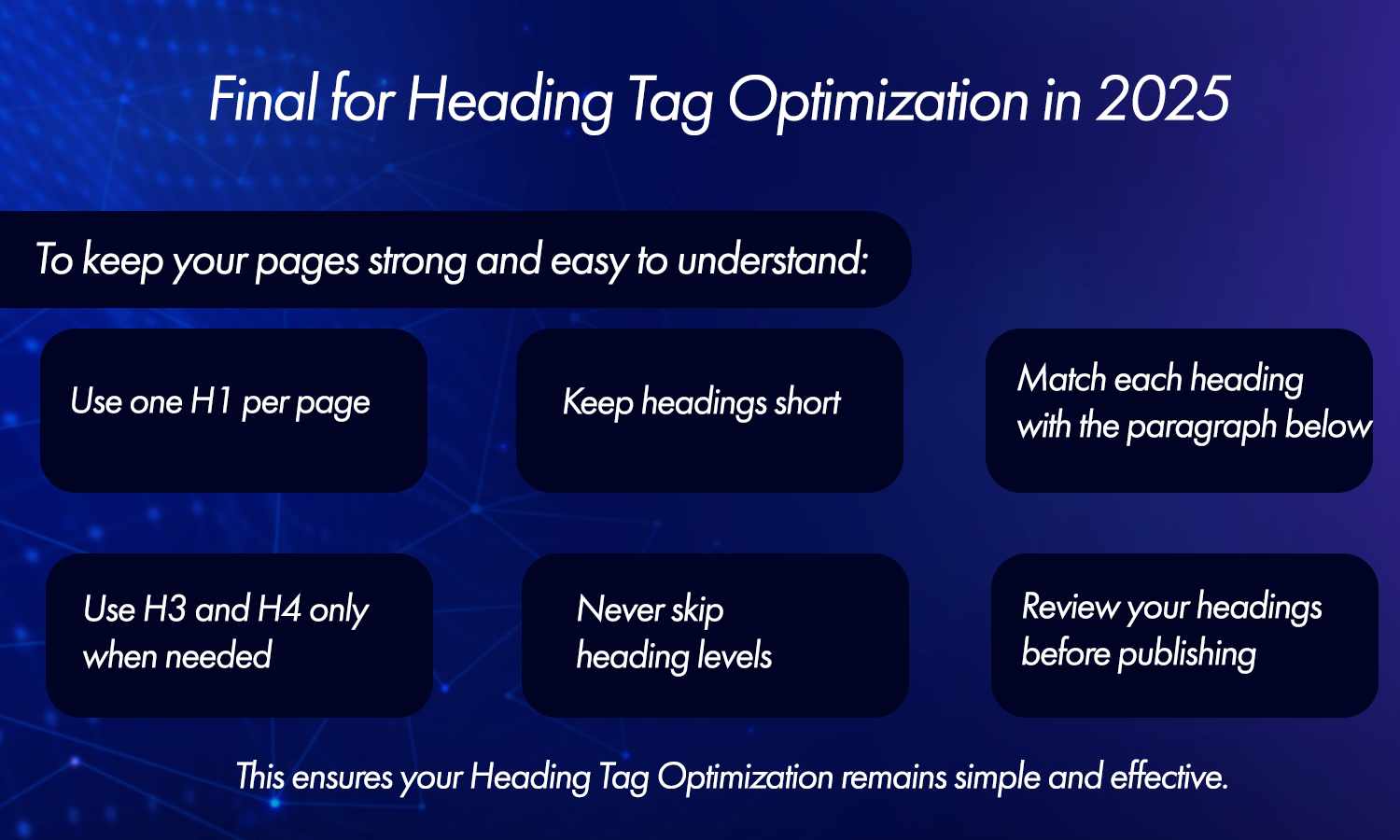
Final for Heading Tag Optimization in 2025
To keep your pages strong and easy to understand:
- Use one H1 per page
- Keep headings short
- Match each heading with the paragraph below
- Use H3 and H4 only when needed
- Never skip heading levels
- Review your headings before publishing
This ensures your Heading Tag Optimization remains simple and effective.
Conclusion
Strong headings help search engines and users understand your content smoothly. When you follow the right Heading Tag Optimization practices, your pages become clearer, cleaner, and easier to scan. With simple structure, correct order, and readable wording, your content is ready for better performance in 2025.
If you want a quick way to check your headings, SEO Dada helps you review every tag in real time so you can fix issues before publishing.
Key Takeaways
- Heading Tag Optimization keeps your content clear and organised.
- Use one focused H1 that matches your topic.
- Follow proper heading levels from H1 to H4.
- Keep all headings short, simple, and meaningful.
- Review your structure before publishing to avoid confusion.