What is SEO Analytics? A Cafe's Journey to Online Visibility
By seodada · Published
Overview
SEO analytics is the practice of collecting and reading data from search engines and websites to understand how a site performs in organic search. It shows which keywords bring visitors, where rankings are rising or falling, and what technical problems hold pages back. This article follows a small café through the process, then shows how to set goals, choose tools, and act on what the data says.
Local café owner reviewing search data on a laptop at the counter
What makes this useful is that each measurement points toward a decision. The sections below walk through one example, step by step.
What is SEO analytics and why does it matter?
Without measurement, you are guessing. You may assume your homepage draws the most search visitors, or that a competitor wins for reasons you cannot see. Analytics replaces those assumptions with measurable facts about rankings, traffic, keywords, and site health.
Why measurement changes decisions
Each number suggests an action. A keyword ranking on page two is a chance to improve one page. A drop across many terms may signal a technical issue that affects the whole site.
How seodada fits into the workflow
seodada brings keyword research, technical audits, rank tracking, and AI visibility into one workspace. You can move from finding a search opportunity to checking the site and tracking the result without switching tools.
Related: Domain Analysis: Organic Traffic and Keywords
Imagine a small cafe: The Daily Grind and its first steps in SEO analytics
A local café owner starts with simple questions about what people see when they search for coffee nearby.
Setting the scene: The Daily Grind's digital dilemma
The café wants more foot traffic from nearby customers and to appear when someone searches for the best coffee in its city. The owner has a basic website but no clear sense of whether it helps.
The first step is to write those goals in measurable terms. Phrases like "more visitors" are vague, so the owner chooses specific searches to track.
Gathering initial data: What's visible now?
The owner checks what the site currently earns. Basic traffic figures show how many visitors arrive from search and which pages they open. Local search queries show the terms people use, such as "espresso near me" or "vegan pastries" paired with the city name.
This first look is rough, but it gives a starting point for measuring later changes.
Benchmarking against competitors: Who's winning local search?
Next, the owner looks at cafés that already rank well. Domain Analysis in seodada profiles any domain with its authority score, estimated organic traffic, and the keywords it ranks for.
In a hypothetical scenario, the owner notices that a competitor ranks for several neighborhood terms the Daily Grind never targeted. That becomes a list of ideas to test. Competitor data is directional, so the owner uses it to spot gaps, not to predict exact visits.
Tracking progress and identifying opportunities with an SEO analytics platform
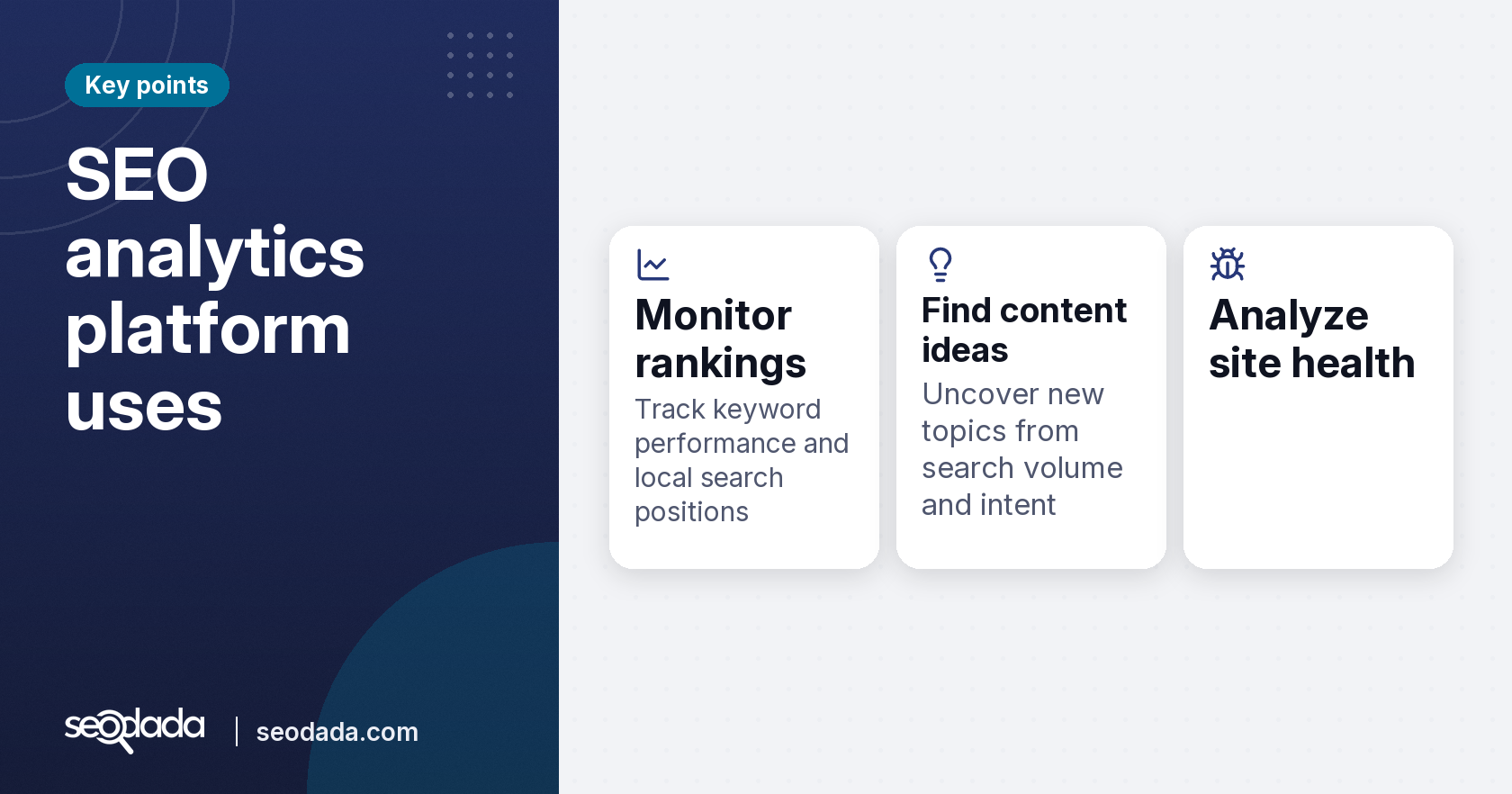
An SEO analytics platform keeps measurements in one place so you can watch changes over time. The café uses it to monitor rankings, check the site, and find content ideas.
Monitoring keyword performance and local rankings
Rank tracking records where the site appears for chosen terms in a set location and on a chosen device. The Daily Grind tracks "espresso near me" and "vegan pastries" for its city. Tracked keywords are re-checked on a regular schedule, and significant movements are flagged so the owner can respond.
Every result is stored, so the owner can compare this month's position with last month's and see whether a new page helped.
Uncovering new content ideas from search data
Keyword data reveals the volume and intent behind each phrase. Some searches are informational, like "how to pick a coffee bean." Others are transactional, such as "coffee shop open now." The café chooses terms that match the visits it wants.
The owner plans one page about its house-roasted beans and another about its weekend brunch. Each page targets a clear question a local customer might ask.
Analyzing website health and user experience
Technical problems can block good content. A URL check confirms that pages return the right status and redirect correctly. On-Page Analysis reviews headings, meta tags, images, and internal links on a page.
The owner fixes a broken menu link and a page that loaded slowly on phones. These changes are small, but they remove barriers between the search result and the visitor.
Refining strategy: How enterprise SEO analytics principles apply to any business
Large companies run complex SEO programs, yet the core habits work for a single café too. Data drives decisions, monitoring continues without pause, and changes are made in small steps.
From cafe to corporation: Scaling data-driven decisions
A large retailer may track thousands of keywords across several markets. The Daily Grind tracks a small set of terms in one city. The method is the same: set a goal, measure it, change something, and measure again.
The power of continuous monitoring and alerts
SEO is a trend, not a snapshot. Scheduled monitoring runs audits and rank checks on a regular cadence, catching slow drifts and sudden drops that an occasional manual check might miss.
When a key term slips, an alert gives the owner a chance to respond before the traffic report shows the loss.
Prioritizing actions with AI-powered insights
An audit can produce a long list of issues. The AI SEO Advisor reads the site's own report data and returns prioritized, plain-English fixes ordered by impact, so the owner knows where to start.
The general lessons: Making SEO analytics work for you
The café example shows a repeatable process. You do not need a large budget to use the same method.
Define your goals and metrics
Start with a clear goal, such as more visits from local searches. Pick a small set of metrics that show progress, like rankings for chosen terms and organic visits to key pages.
Connect a search metric to a page outcome
Suppose the Daily Grind's ranking for "vegan pastries" rises from page two to the top five. Ranking alone is only visibility. The owner then checks whether organic visits to the pastry page grew and whether those visits led to orders or store visits. If the ranking improved but visits did not, the next decision is to improve the page's title, opening section, or photos to earn more clicks. If visits rose but orders did not, the decision shifts to the menu and calls to action. Each metric leads to a different follow-up.
Choose the right tools for your needs
Pick tools that cover the work you actually do. An integrated platform reduces the number of places you need to look. Plans differ by websites, analysis credits, and tracked keywords, so a single site and a larger portfolio can both fit.
Act on your data and iterate
Measure, change one thing, and measure again. Keep the changes that help and drop the ones that do not. Over time, small adjustments add up to clear gains in visibility.
Key takeaways
- SEO analytics measures search data from search engines and websites to guide improvements.
- The Daily Grind starts with its goals, current visibility, and competitor keywords.
- Rank tracking, keyword research, and site checks show where to focus effort.
- Scheduled monitoring and alerts catch changes before they become losses.
- Clear goals, the right tools, and steady iteration make the method work at any size.
Conclusion
Reading search data well lets you make better decisions about your site. The Daily Grind shows how a small business can start with simple questions and grow into a steady routine of measuring and adjusting. Begin with one goal, track a few terms, and let the data show you the next step.
FAQs
What is the difference between SEO analytics and web analytics?
Web analytics measures all visitor activity on a site, from any source. SEO analytics focuses on organic search performance, including rankings, search keywords, and the technical health that affects search visibility.
How often should I review my SEO analytics?
Check rankings and traffic figures on a regular basis. Scheduled checks can run on their own so you review the trends and act on alerts instead of running every report by hand.
Can SEO analytics predict future trends?
Analytics shows past and current patterns, and those patterns can suggest likely directions. Treat forecasts as estimates, since search results and competitors change over time.
What are the key metrics to track in SEO analytics?
Common metrics include keyword rankings, organic traffic to key pages, keyword search volume, and technical issues found in audits. Choose the few that link directly to your goal.
How do I set up SEO analytics for a new website?
Begin by defining your goals and listing the terms your customers use. Set up rank tracking for those terms, run a site audit, and record your starting numbers so you can measure change later.
Is SEO analytics only for large businesses?
No. The method works at any size. A small business can track a handful of local keywords and still follow the same cycle of measuring, changing, and measuring again.
What role does AI play in modern SEO analytics?
AI can help rank audit findings by impact and explain them in plain language. It also helps track how often a brand appears in AI-generated answers, which is becoming part of search visibility.
Frequently asked questions
What is the difference between SEO analytics and web analytics?
Web analytics measures all visitor activity on a site, from any source. SEO analytics focuses on organic search performance, including rankings, search keywords, and the technical health that affects search visibility.
How often should I review my SEO analytics?
Check rankings and traffic figures on a regular basis. Scheduled checks can run on their own so you review the trends and act on alerts instead of running every report by hand.
Can SEO analytics predict future trends?
Analytics shows past and current patterns, and those patterns can suggest likely directions. Treat forecasts as estimates, since search results and competitors change over time.
What are the key metrics to track in SEO analytics?
Common metrics include keyword rankings, organic traffic to key pages, keyword search volume, and technical issues found in audits. Choose the few that link directly to your goal.
How do I set up SEO analytics for a new website?
Begin by defining your goals and listing the terms your customers use. Set up rank tracking for those terms, run a site audit, and record your starting numbers so you can measure change later.
Is SEO analytics only for large businesses?
No. The method works at any size. A small business can track a handful of local keywords and still follow the same cycle of measuring, changing, and measuring again.
What role does AI play in modern SEO analytics?
AI can help rank audit findings by impact and explain them in plain language. It also helps track how often a brand appears in AI-generated answers, which is becoming part of search visibility.