
Why URL Structure for SEO Plays a Key Role in Website Success
In 2026, URL Structure for SEO remains one of the most underestimated elements of website performance. While algorithms have become more advanced, URLs still act as the digital address system that both search engines and users rely on to understand where they are and what a page is about.
A well-structured URL provides context even before a page loads. It signals relevance, shows content hierarchy, and influences whether a user clicks or scrolls past. Poorly structured URLs, on the other hand, confuse crawlers, reduce trust, and quietly limit organic visibility.
Simply put, URL structure in SEO works like a roadmap. If the roadmap is unclear, both search engines and users struggle to reach the destination.
Why URL Structure Is Important for SEO?
URL Structure for SEO directly affects how efficiently search engines crawl and index a website. Search bots use URL paths to understand how pages relate to one another and which sections of a site matter most.
A clean URL such as
/products/shoes/running-shoes
clearly defines category and intent. In contrast, URLs filled with random parameters or IDs often lead crawlers down irrelevant paths, causing important pages to be skipped entirely.
URLs also help signal topic relevance. Including meaningful keywords in the slug gives search engines immediate context about the page. In 2026, keyword-optimized URLs continue to show measurable ranking improvements, often helping pages rank higher by an average of 1–2 positions.
Beyond algorithms, URL structure influences user behaviour. Descriptive URLs are consistently shown to earn up to 45% higher click-through rates, as users are more confident clicking links that clearly match their search intent.
How Clean URL Structure Improves User Experience
A clean URL Structure for SEO plays a major role in how users perceive and interact with a website. URLs function as digital breadcrumbs, helping users understand their location within a site’s hierarchy.
When someone lands on
example.com/services/web-design,
They immediately know what the page contains and where it fits within the site. This clarity reduces frustration and allows users to navigate intuitively, even by trimming the URL to reach broader categories.
Readable URLs also build trust. In 2026, users are cautious of links that look suspicious or spam-like. Messy URLs with strings of numbers and symbols reduce confidence and lower engagement. Clean URLs, on the other hand, support accessibility, work better with screen readers, and are easier to share across mobile apps and social platforms.
As voice and AI-driven search continue to grow, URLs that mirror natural language are also easier for digital assistants to match with user queries, further strengthening visibility.
URL Structure for SEO and Website Rankings
URL Structure for SEO may not be the strongest standalone ranking factor, but its combined impact on crawlability, security, and user signals makes it essential for rankings in 2026.
Search engines prioritize HTTPS URLs, treating security as a confirmed ranking signal. Non-secure URLs are increasingly flagged as unsafe, which directly affects trust and visibility. Logical URL hierarchies also improve crawl efficiency, ensuring search bots do not waste crawl budget on broken or repetitive paths.
User behaviour amplifies these effects. Clean, keyword-rich URLs earn higher click-through rates, which sends positive engagement signals to search engines. When URLs are shared as plain links on social media or forums, the keywords within them often act as anchor text, adding additional relevance.
Together, these factors explain why well-structured URLs consistently outperform generic or cluttered ones in competitive search results.
How to Fix and Optimize Existing URLs
Fixing an existing URL Structure for SEO in 2026 requires precision, not guesswork. Most websites already have indexed pages, backlinks, and traffic, so careless changes can cause ranking losses.
Many sites still rely on URLs like /page1.html or /p?id=123, which offer no context to users or search engines. Others bury important pages under deep folder structures, making them harder to crawl. URLs with dates such as /2023/seo-tips/ also limit longevity, making evergreen content appear outdated.
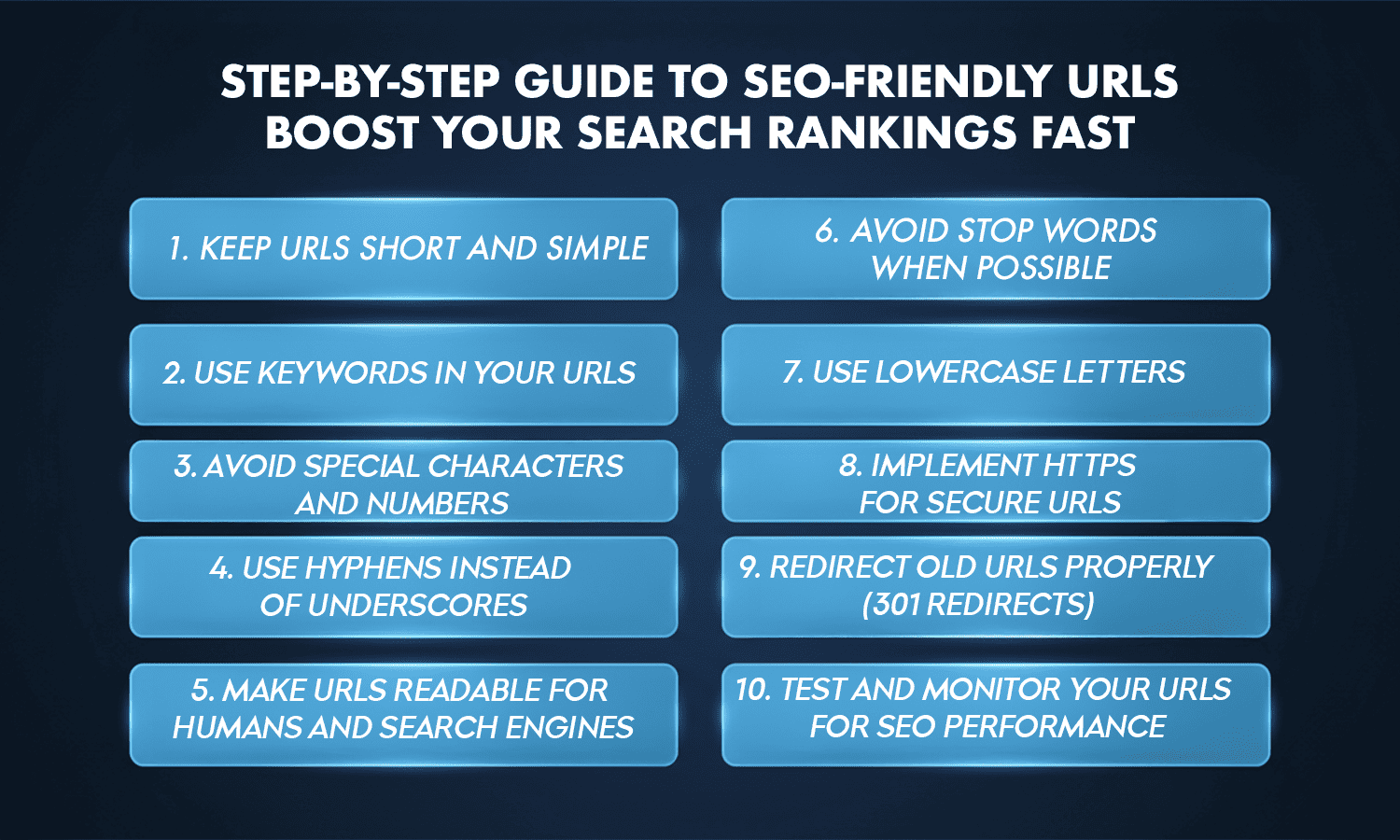
Optimized URLs should be rewritten using 3–5 meaningful words, kept within 50–60 characters, written in lowercase, and separated by hyphens. Unnecessary filler words should be removed to maintain focus and clarity.
Any URL change must be supported by a 301 redirect, which tells search engines the page has permanently moved and preserves existing ranking value. Skipping this step leads to broken links and immediate visibility loss. Redirect chains should also be avoided, as multiple hops weaken crawl efficiency.
Once updates are complete, internal links should be refreshed, XML sitemaps regenerated, and indexing monitored closely. Platforms like SEODADA.com help streamline this process by scanning URLs, identifying crawl issues, and highlighting structural problems that affect SEO performance.
Common URL Structure Mistakes to Avoid
Poor URL practices continue to damage SEO performance in 2026. Avoiding these mistakes is critical for maintaining clarity and trust.
- Using underscores (_) instead of hyphens (-)
- Adding years or dates to URLs for evergreen content
- Mixing uppercase and lowercase letters
- Creating overly long URLs stuffed with repeated keywords
- Relying on dynamic parameters like ?id=84739&session=XYZ
- Building deep directory structures that bury important pages
- Being inconsistent with trailing slashes across URLs
A strong URL Structure for SEO focuses on simplicity, consistency, and relevance.
Conclusion
In 2026, URL Structure for SEO is no longer just a technical consideration. It is a signal of quality, trust, and search readiness. Clean URLs help search engines understand your site, help users trust your content, and help pages perform better across search, mobile, and voice platforms.
Tools like SEODADA.com are designed to make this process practical and data-driven. By analyzing URL paths, detecting crawl inefficiencies, and highlighting structural issues, SEODADA enables teams to optimize URLs with clarity rather than assumptions.
A well-structured URL may seem small, but its impact on visibility, engagement, and long-term growth is anything but.