Compare Competitor Backlink Analysis Tools for SEO Success
By seodada · Published
Overview
A competitor backlink analysis tool shows which websites link to a rival, how strong those links are, and what anchor text they use. Comparing these tools helps you spot link building opportunities and risks. This article compares seodada's Backlink Intelligence with its competitor keyword and domain tools, then recommends which one fits each use case.
This tool is a competitor backlink analysis tool. It helps you. Use it to find where a competitor's strength comes from, including referring domains, link authority, and anchor text. If you want to improve your link strategy, this competitor backlink analysis tool can help you decide what to copy, avoid, or outdo in your own strategy, with full details about links, domains, and text.
Why is competitor backlink analysis essential for your strategy?
Competitor backlink analysis shows where a domain's authority comes from. You can then find link opportunities and avoid the risks in a rival's profile. Links are still how the web votes on authority, so reading them shows what search engines may reward.
A link profile shows the strength behind a domain, and it hides risks you only see when you read the pattern. A rival with many links from unrelated sites may look strong, but that profile can be fragile.
Quality and relevance matter more than volume. If you ask about each linking site, it should make sense to a real reader in that niche. A few authoritative links from sites in your field usually do more than hundreds of weak links from unrelated pages.
Anchor text is a quick risk check. This check shows if most anchors are exact-match commercial phrases. If so, the profile may look manipulated, as a natural profile mixes brand names, plain descriptions, and some commercial terms. For a deeper look at building links, read Backlinks in SEO Explained: 5 Strategies to Build Authority.
How do you perform competitor backlink analysis?
Start with a backlink tool that lists referring domains and anchor text for each rival. Then compare those results against your own profile. seodada's Backlink Intelligence reports how many distinct sites link to a domain, which individual links carry the most authority, and which anchor text those links use.
The tool counts unique linking sites, not raw link totals. One site that links a hundred times is one referring domain, which makes it a truer measure of authority. It also shows the individual backlinks doing the most work, so you know what to protect and what to pursue.
When the backlink index has no data for a domain, seodada's authority score still comes from Open PageRank. The page notes where the score comes from, so you can judge how much weight to give it.
For competitor research, seodada's three tools cover different tasks. The table below shows which one to start with.
Understanding referring domains and authority scores
A referring domain is a unique website that links to your site or a competitor's site. Count the domains, not the links. A single blog that links five times adds one referring domain.
This score is a comparative measure of a domain's strength. It helps you size up a rival. Google may not use it in this way. Compare scores between domains in the same market, and do not treat one number as a final verdict.
Analyzing anchor text profiles for risk signals
You should check if the most common anchors read like natural recommendations. Brand names and plain phrases are normal. A list dominated by exact-match money keywords is a warning sign, so it needs your attention.
If a competitor's anchor profile looks skewed, do not copy it. Build links with varied, natural anchors that match the linking page.
Comparison table: seodada tools for competitor analysis
| Tool | Main question it answers | Best for |
|---|---|---|
| Backlink Intelligence | Which sites link to a rival, and how strong are those links? | Link building and link risk checks |
| Competitor Keyword Gap Analysis | Which keywords does a rival win that you do not? | Content and keyword opportunities |
| Domain Analytics | How strong is a rival overall, and what drives its traffic? | A broad view of a competitor's search footprint |
Beyond backlinks: what other competitor insights matter?
Backlinks show where authority comes from. It is about keywords, too. Overall domain strength shows how big that competitor is, and using all three gives a fuller picture than links alone.
No. Keyword gaps are often the fastest route to new content. Domain profiles show what carries a rival's traffic, and together they show where to focus next, which is very useful.
Identifying keyword gaps and shared terms
seodada's competitor keyword gap analysis compares your domain against one or more rivals. It splits the keyword sets into terms you both rank for, terms only they rank for, and terms only you rank for. This helps you understand the gaps.
The gap list is the most useful output. It shows real keywords with real search volume that a competitor already wins and you do not. If you compare against rivals, that shows gaps common across your market without flooding you with one-off terms.
For a step-by-step method on keyword analysis, see How to Analyze Competitor Keywords for Better Ranking. For finding low-competition terms in the gap list, see How to Find Low Competition Keywords in 5 Steps.
Profiling overall domain authority and traffic
Domain Analytics profiles any domain with its authority score, estimated organic traffic, and the full list of keywords it ranks for. Each keyword shows its position and volume, so you can see which pages and terms do the real work.
Use it to decide if you are competing up or down. The traffic estimate is a model, so use it to compare domains and spot trends. For more on reading this data, see Domain Analysis: Organic Traffic and Keywords.
Which competitor backlink analysis tool suits your needs?
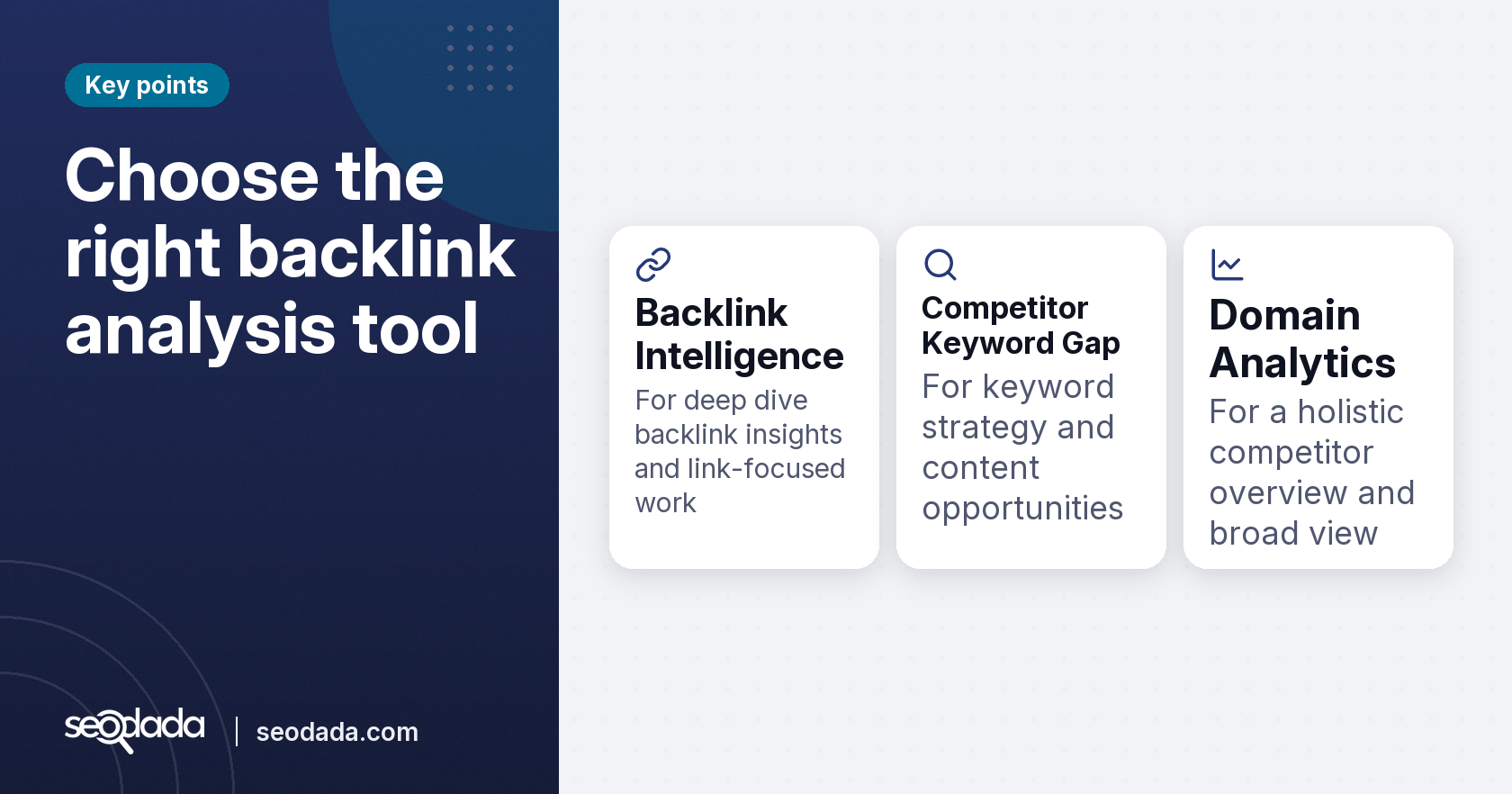
Pick the tool that matches your main question. Backlink Intelligence suits link-focused work. Competitor Keyword Gap Analysis suits content planning, and Domain Analytics suits a broad overview, which is very helpful.
For deep dive backlink insights
It shows which referring domains matter and which anchors look risky. If a rival's links come from weak or unrelated sites, that is a signal to build better links in their place.
For keyword strategy and content opportunities
Choose Competitor Keyword Gap Analysis if you need content ideas now. A small business with a limited budget can use the gap list to pick a few pages to write. Each gap is a term with proven demand that you are missing.
For a holistic competitor overview
Choose Domain Analytics for a broad view of a rival's performance. An agency preparing a client report can use it to show a competitor's authority, traffic, and keyword footprint in one place. It answers what content drives a rival's visibility.
Our recommendation for comprehensive competitor research
For a complete picture, combine Backlink Intelligence, Competitor Keyword Gap Analysis, and Domain Analytics. Start with Domain Analytics to size up a rival. Then use Backlink Intelligence to understand its link sources, and the gap tool to find content to write.
It brings keyword research, technical audits, rank tracking, and AI visibility into one workspace. You use seodada for this. Plans differ in websites, analysis credits a month, and tracked keywords, not in the core tools. This means you get full control. Use the Free SEO Tools & Features page to view the full set on seodada, which offers 22 tools across 4 groups, including technical audits, keyword research, and rank tracking, so you do not need several products.
Key takeaways
- A competitor backlink analysis tool shows where a rival's authority comes from.
- Count referring domains, not raw links, and prioritize quality and relevance.
- A skewed, exact-match anchor profile is a risk signal worth checking.
- Keyword gaps give you a practical list of proven terms to target.
- Match the tool to your goal, or combine all three for a complete view.
Conclusion
Competitor backlink analysis helps you see where rivals get their authority and where risks sit. Choose the tool that fits your main question. Use Backlink Intelligence for links, the gap analysis for content, and Domain Analytics for an overall view. If you want all three in one place, seodada's platform covers them, and you can see the full set of features to decide where to start.
FAQs
What is a referring domain?
One site. A referring domain is a unique website that links to a site. This makes it a better measure of authority than raw link totals, as one site with many links still counts as one referring domain.
How many competitors should I analyze?
You need a practical range of rivals to find gaps. This is enough to find common gaps without collecting too many one-off terms. Start small and add more only if you need a wider view.
Can I use these tools for my own website?
Yes. The same tools that profile a competitor can also profile your own domain. Compare your results against rivals to see where you lead and where you fall behind.
What is an authority score?
An authority score is a comparative measure of a domain's strength. It helps you size up a rival, but it is not a metric Google uses directly. Use it to compare domains, not as a final judgment.
How often should I perform competitor analysis?
Review competitors on a regular schedule, such as every quarter, and check sooner if a rival's traffic or rankings change sharply. Regular reviews show trends rather than one-off snapshots.
Do backlinks still matter for SEO?
Yes, links remain one of the strongest signals of authority. Quality and relevance count more than volume, so a few trusted, on-topic links often outweigh many weak ones.
Frequently asked questions
What is a referring domain?
One site. A referring domain is a unique website that links to a site. This makes it a better measure of authority than raw link totals, as one site with many links still counts as one referring domain.
How many competitors should I analyze?
You need a practical range of rivals to find gaps. This is enough to find common gaps without collecting too many one-off terms. Start small and add more only if you need a wider view.
Can I use these tools for my own website?
Yes. The same tools that profile a competitor can also profile your own domain. Compare your results against rivals to see where you lead and where you fall behind.
What is an authority score?
An authority score is a comparative measure of a domain's strength. It helps you size up a rival, but it is not a metric Google uses directly. Use it to compare domains, not as a final judgment.
How often should I perform competitor analysis?
Review competitors on a regular schedule, such as every quarter, and check sooner if a rival's traffic or rankings change sharply. Regular reviews show trends rather than one-off snapshots.
Do backlinks still matter for SEO?
Yes, links remain one of the strongest signals of authority. Quality and relevance count more than volume, so a few trusted, on-topic links often outweigh many weak ones.