
Introduction
Keyword density sounds technical, but it is actually simple. It just tells you how often a keyword appears in your content compared to the total words. Many people worry about hitting the “perfect” number, and some even overdo it. That can hurt more than help.
In this blog, we will break down what keyword density is, whether it matters today, what range is safe, how to avoid stuffing, and how we check it inside Seodada.
What Is Keyword Density?
Keyword Density is the percentage of times a keyword appears in a page compared to the total word count.
Example:
If your focus keyword appears 10 times in a 1,000-word page, the keyword density is 1%.
That is all it means. It is not a magic score. It is just a way to measure repetition.
Tools like a keyword density checker help you calculate this quickly without manual counting.
Does the Density of Keywords Matter for SEO?
Yes, but not in the old way. Search engines no longer rank pages just because a keyword shows up a lot. They rank pages that solve the searcher's problem clearly.
So the density of keywords for seo matters only because:
- It helps search engines understand your topic
- It keeps your page focused
- It prevents overuse that looks spammy
If a keyword is missing completely, Google may not understand your page.
If a keyword is overused, it can look unnatural.
So the balance matters, not the exact number.
What Is a Good Keyword Density?
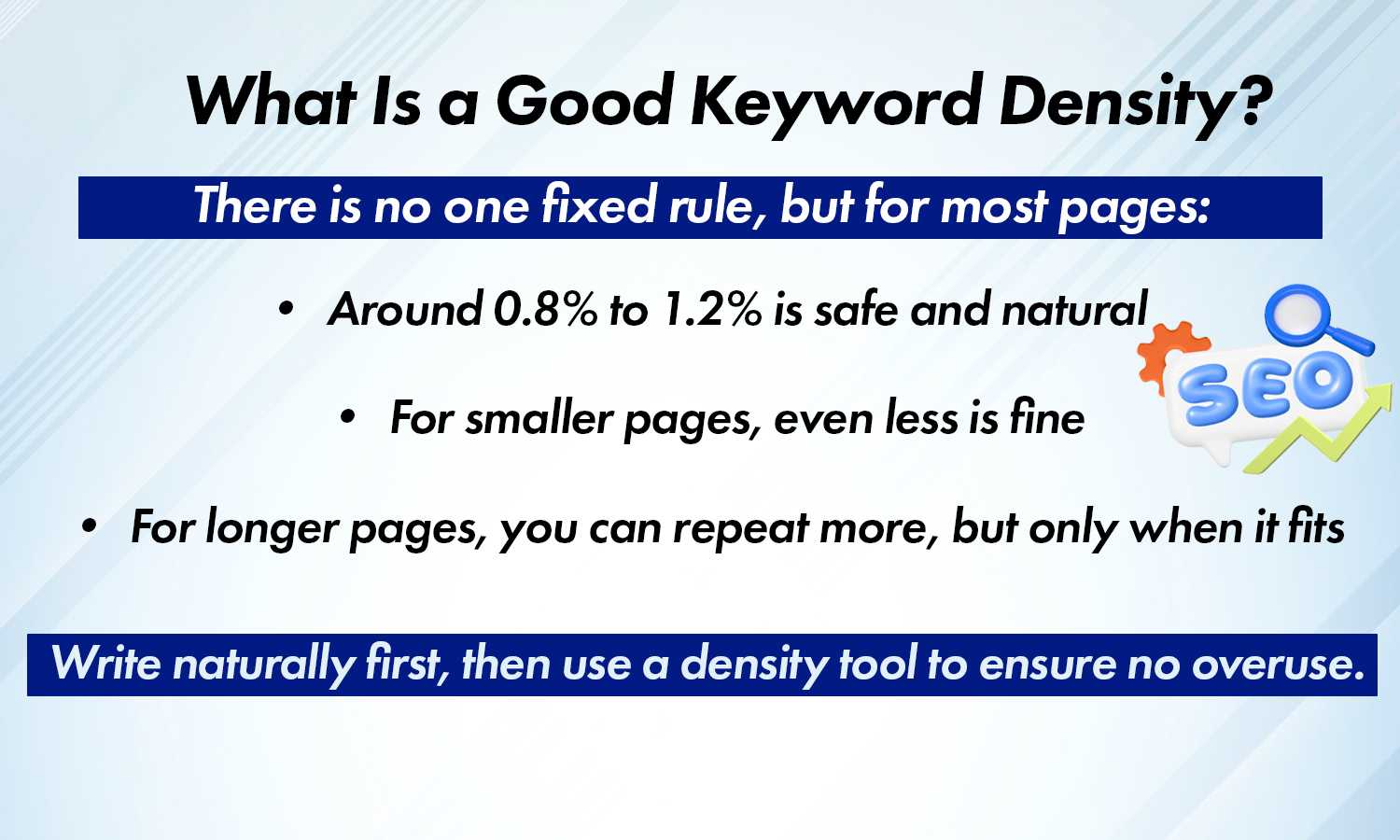
There is no one fixed rule, but for most pages:
- Around 0.8% to 1.2% is safe and natural
- For smaller pages, even less is fine
- For longer pages, you can repeat more, but only when it fits
Instead of aiming for a number first, aim for natural writing. Then check the density to confirm you did not overdo it. A keyword density analyzer makes this easy.
Keyword Density vs. Keyword Stuffing
This is where many sites go wrong.
Keyword Density is natural repetition that supports your topic.
Keyword stuffing is forcing the same keyword too many times, even when it does not fit.
Stuffing usually looks like this:
- The keyword appears in every line
- Sentences sound repetitive
- Reading feels unnatural
That is why we include a keyword stuffing checker in Seodada. It flags pages where repetition becomes a problem.
You can also check keyword stuffing manually by reading your content out loud. If it sounds weird, it probably is.
How to Check Keyword Density on Your Website
You can do it in two simple ways.
1. Use a tool
Paste text into a keyword density tool and it will show:
- Focus keyword count
- Density percentage
- Repeated phrases
- Related terms
A seo keyword density checker is useful when you are updating older pages or writing new ones.
2. Manual check
If you want a quick idea, copy your content into a doc and use a keyword counter to count your main keyword. Then divide by total words to get the percentage.
A proper keyword counter tool saves time if you have multiple pages.

4 Keyword Density Best Practices
1. Include Keywords in Important Places
Put your focus keyword in places that matter, like:
- Title
- First paragraph
- H1
- H2 if needed
- Conclusion
Do not force it into every heading. Use a density checker after writing to confirm the balance.
2. Cover Topics Comprehensively
When you write fully on a topic, keywords appear naturally. You do not need to push them.
3. Prioritize Meeting Search Intent
Search intent matters more than density. If your content solves what the reader wants, density usually comes out right.
4. Create Topic Clusters
Write supporting pages around the same theme. That way, one page does not need to carry every keyword. A keyword density checker tool helps you keep each page focused.
Leverage Keywords to Boost Your SEO Strategy
Keyword density is just one small part of SEO. The real win is when you:
- Choose the right keyword
- Match intent
- Write clearly
- Build supporting content
- Update pages based on results
If you want a fast way to audit content, Seodada lets you run a full check keyword density tool scan, so you see which pages are too light and which ones are overused.