
Keyword Research Made Simple — Beginner’s Guide for 2026
If you’re new to SEO, it’s very easy to feel lost when someone says “do your Keyword Research.” What tools should you use? Which keywords matter? How do you even know if a keyword is good or bad?
This guide is written in a simple, beginner-friendly way so you understand exactly how Keyword Research works in 2026, what has changed, and how to build a solid foundation for your website. Let’s break this down step by step.
What Is Keyword Research?
Before diving deeper, let’s answer a very basic question: what is keyword research in the simplest terms? It is the process of finding out what people are searching for in Google and then using that information to create pages, blogs, or product descriptions that match those searches.
A good seo keyword research approach helps you understand your audience better, plan your content properly, and avoid writing pages that nobody is interested in.
Why Keyword Research Still Matters in 2026
Even with AI-generated content and smarter search engines, Keyword Research still plays a huge role. Google is shifting towards understanding meaning and search intent, but the foundation remains the same — you must know what people are searching for before you decide what to write.
A simple keyword search can reveal:
- Questions your audience really cares about
- Hidden opportunities with low competition
- Trending topics you can take advantage of
When done properly, Keyword Research keeps your content relevant, structured, and aligned with actual search behaviour.
Types of Keywords Every Beginner Must Know
There are a few keyword types you should always be aware of when doing keyword research in seo:
1. Short-Tail Keywords
One- or two-word searches like “shoes” or “laptop.” These get massive volume but are extremely competitive.
2. Long-Tail Keywords
Longer and more specific phrases like “best running shoes for flat feet.” This is where long tail keyword research gives you easier wins.
3. Local Keywords
Searches with a location added, like “hair salon in Bangalore.” You’ll cover this later under local keyword research, which is critical for service-based businesses.
4. Competitor Keywords
These are keywords your competitors already rank for. Studying them helps you do smarter competitor keyword research and avoid gaps in your content.
How to Do Keyword Research Step-by-Step (2026 Updated Method)
A lot has changed in SEO, but the method is still simple if you follow a clean process. Here’s how to how to do keyword research without confusion.
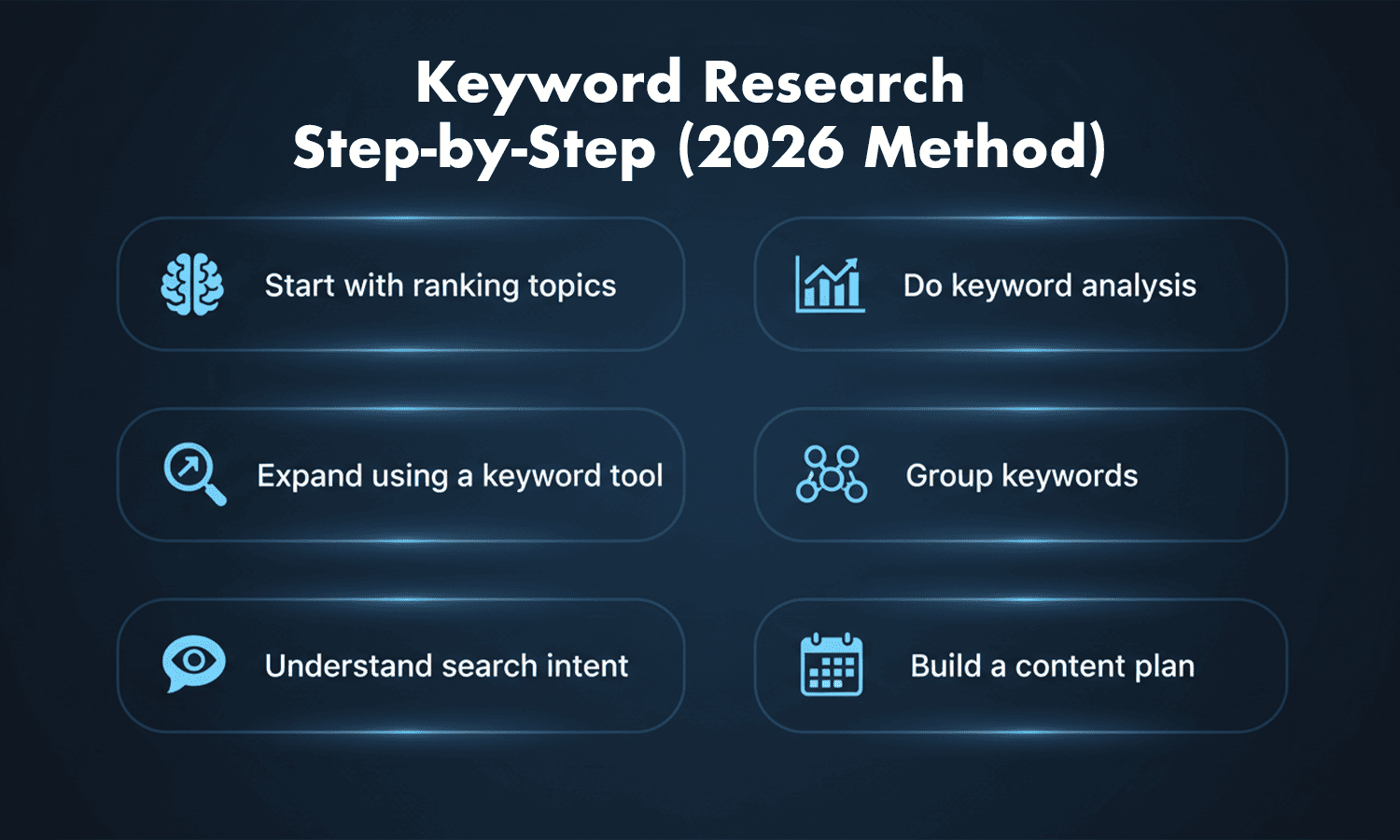
Step 1: Start With Topics You Want to Rank For
Write down 5–10 topics around your business. For example, if you run a fitness brand, your topics could include workouts, weight loss, diet plans, and supplements.
Step 2: Expand Using a Keyword Tool
Use any keyword tool to explore related searches, variations, questions, and comparisons. You don’t need complex tools — even basic ones can give you a strong starting point.
Step 3: Understand Search Intent
Check the top results in Google to see what users expect. If the page is a listicle, blog, or product page, match it.
Step 4: Do a Light Keyword Analysis
A basic keyword analysis helps you understand which phrases are easy wins and which ones need more authority.
Step 5: Organize Your Keywords Into Groups
This is where many SEO Keyword Research Mistakes happen. Group similar keywords together and map them to specific pages instead of targeting them randomly.
Step 6: Build Your Content Plan
Create a content list based on all the keyword groups. This becomes your SEO roadmap for the next 3–6 months.
Best Keyword Research Tools for 2026
You don’t need every tool on the market. A simple combination is more than enough for clean keyword research seo:
- A tool for keyword suggestions
- A tool to check competition
- A tool to monitor rankings
Most beginners spend more time switching tools than actually researching. Pick one and stay consistent.
How to Analyze Keywords Like a Pro
Once you find keywords, you must evaluate them. Here’s a quick way to do proper keyword analysis:
- Check if the search intent matches your content
- Look at keyword difficulty
- Check if the keyword aligns with your business goals
- Review the top results for content structure
- See whether the keyword can bring meaningful traffic
This is where keyword research seo becomes smarter — you’re not just collecting words, you’re understanding how they actually help your site grow.
Long-Tail Keyword Research for Easy Rankings
If you are just starting, long-tail keywords should be your best friend. They bring lower volume, but the people searching for them are more serious.
Good long tail keyword research helps you get rankings faster because fewer websites compete for these terms. These also convert better since the search intent is clearer.
Local Keyword Research for Location-Based SEO
If your business serves a city or region, do not skip local keyword research. People often search with phrases like:
- “near me”
- “open now”
- “in Chennai”
- “in Mumbai”
Local terms help you attract customers who are close to taking action. This is one of the easiest ways to bring relevant traffic if you run a service-based brand or a physical store.
Future of Keyword Research — AI + SEO Predictions for 2026
AI tools are getting better at understanding what users want. ChatGPT, Gemini and similar tools are already influencing how people discover information.
However, the core of how to keyword research remains the same:
- Understand what people search
- Match their intent
- Provide useful content
In 2026, the only real change is that keyword tools will become smarter, and SERPs will show more interactive results. But Keyword Research will still be the foundation of SEO.
Make Keyword Research Easier with Seodada
Keyword Research does not have to feel complicated. When you follow a simple process and focus on what your audience actually wants, everything becomes easier — your content, your rankings, and your results.
This is exactly why we built Seodada.
With Seodada, you can:
- Discover new keyword opportunities
- Analyze your competitors’ keywords
- See which topics your site is already ranking for
- Track performance clearly and update your keyword plan
If you want a simple, structured way to improve your keyword strategy in 2026, Seodada makes the entire process far more manageable.