
10 Biggest SEO Keyword Research Mistakes You Must Avoid
When people say “SEO is not working,” most of the time, the problem started long before the content went live. It usually begins with a messy keyword plan. The wrong topics, vague intent, or random phrases pulled from a tool. That is how most SEO Keyword Research Mistakes happen.
In this blog, let us go through ten common mistakes so you can look at your own process and fix what is actually going wrong instead of blaming only content or Google updates.
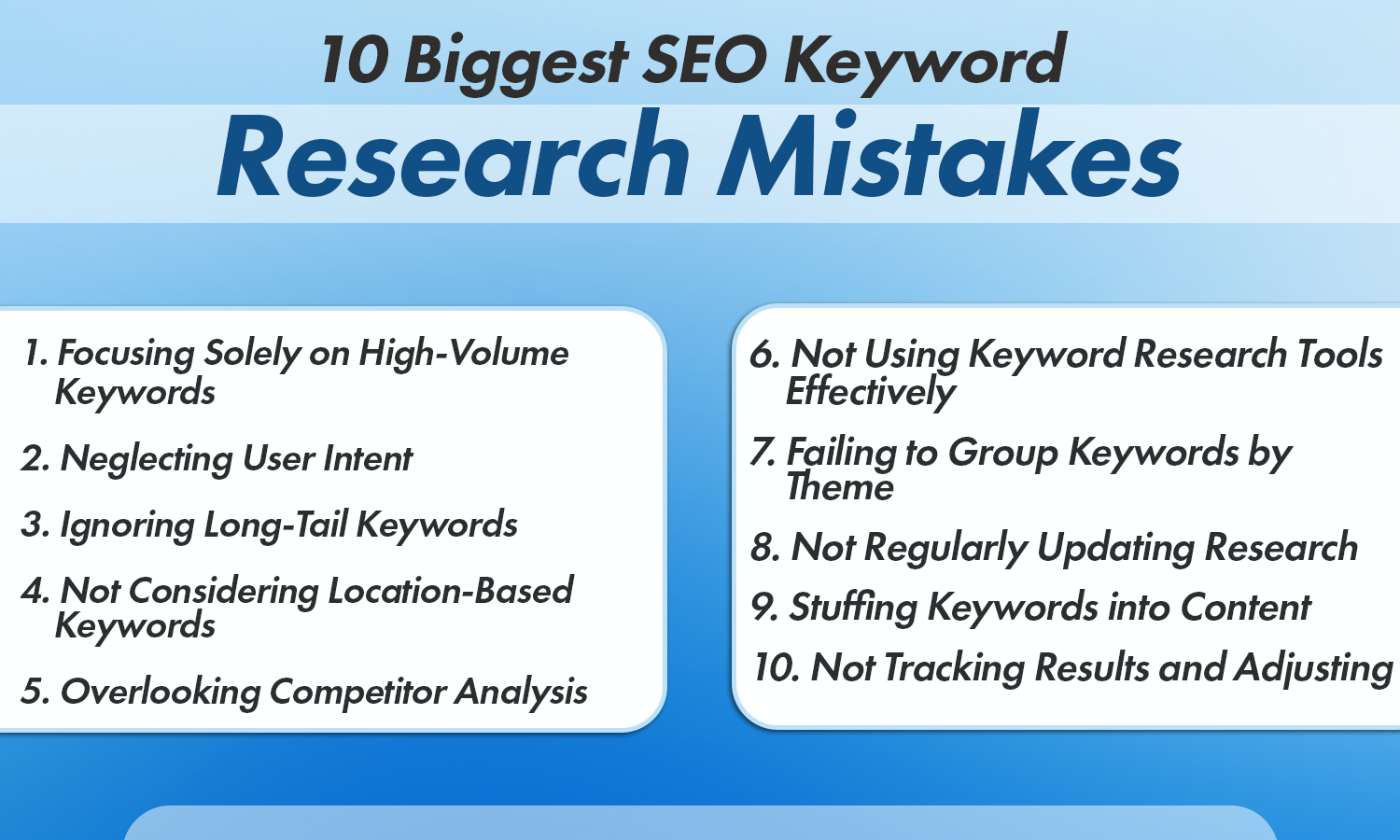
1. Focusing Only on High-Volume Keywords
One of the biggest SEO Keyword Research Mistakes is chasing only big numbers. A quick seo keyword search in a tool shows high volume, and it feels attractive. But those terms are usually very broad and very competitive.
Good keyword research for seo is not about picking the largest number. It is about finding keywords that match your audience, your offer, and your realistic chance of ranking.
2. Neglecting User Intent
Another common mistake is ignoring why someone searched that keyword in the first place. Are they trying to learn, compare options, or buy now?
When you separate keyword research and seo, you end up with content that does not match the intent. For example, a hard-sell page for an informational keyword will push people away. A long theory article for a “buy now” term will not convert.
3. Ignoring Long-Tail Keywords
Long-tail keywords are slightly longer, more specific phrases. They often have lower volume but much clearer intent.
If you only go after head terms, you are repeating one of the classic SEO Keyword Research Mistakes. A balanced keyword research seo approach includes long-tail terms that bring smaller but more qualified traffic over time.
Consistent work like this supports your organic seo keyword research because you slowly build depth around a topic instead of relying on one or two main phrases.
4. Not Considering Location-Based Keywords
If your service or product is tied to a city or region and you ignore local search, you are leaving money on the table.
Local seo keyword research helps you add city names, areas and regions to your plan so you can reach people who are actually ready to act nearby. “Plumber in Chennai” behaves very differently from just “plumber.”
This is one of those SEO Keyword Research Mistakes that quietly reduces conversions even if your traffic looks decent.
5. Overlooking Competitor Analysis
Many people do keyword work in isolation. They never look at which keywords competitors are already winning for.
A simple seo keywords research check on competitors can show you:
- Topics you have completely missed
- Pages that bring them steady traffic
- Gaps where you can create something better
Ignoring this is another easy way to repeat the same SEO Keyword Research Mistakes year after year.
6. Not Using Keyword Research Tools Properly
Tools are not magic, but they are very useful if you use them well. The mistake here is either not using tools at all, or only glancing at volume and moving on.
Smart keyword seo research means you look at:
- Volume and difficulty
- Related questions and phrases
- What kind of pages rank for that keyword
This is where a simple keyword research process seo teams can follow makes life easier. You are not just pulling random lists; you are reading what the data is actually telling you.
7. Failing to Group Keywords by Theme
Another big mistake is treating every keyword separately. When you do that, you either create too many weak pages or cram everything into one messy article.
Instead, your seo keyword research process should group similar phrases into themes, give each group a main keyword, and then decide whether it needs its own page or fits inside an existing one.
This reduces confusion for both readers and search engines and avoids many structural SEO Keyword Research Mistakes.
8. Not Updating Keyword Research Regularly
Search behaviour changes. New products appear, trends shift, and competitors publish fresh content. If you only did research two years ago and still follow that list, your plan is outdated.
You should see keyword research in seo as something you revisit. Even a light refresh every few months can show you new angles, dropping topics, and pages that deserve an update.
9. Stuffing Keywords into Content
Keyword stuffing happens when you force the same term into every second sentence. This is one of the most obvious SEO Keyword Research Mistakes, and it still happens.
Instead of helping, it makes your content hard to read and may even hurt performance. A cleaner seo and keyword research mindset is to place your main terms in titles, headings, intros and conclusions, then let the rest of the copy flow naturally.
You can always research seo keywords again later if you need to fine-tune or refresh the page.
10. Not Tracking Results and Adjusting
The final mistake is doing all this work and then not measuring what happened. If you never check performance, you will not know which topics are working and which are failing.
Your keyword research process seo wise should always end with tracking. See which pages gained visibility, which stayed flat, and which keywords started appearing that you did not plan for. That is how you avoid repeating the same SEO Keyword Research Mistakes and slowly improve your strategy.
Conclusion: Fixing SEO Keyword Research Mistakes with Seodada
Almost every site makes some version of these SEO Keyword Research Mistakes. The difference is whether you keep repeating them or use them as feedback to improve your process.
When your keyword work is guided by clear data and simple systems, keyword research and seo stop feeling like guesswork. You know what to write, why you are writing it, and how to measure the results.
This is exactly where Seodada comes in.
With Seodada, you can:
- See what your pages are already ranking for
- Spot gaps and weak areas in your keyword coverage
- Track how changes to your content affect visibility over time
Instead of juggling spreadsheets and multiple dashboards, you get one place to understand your keywords, your pages, and where to go next. If you want to clean up your SEO Keyword Research Mistakes and build a more reliable plan, Seodada gives you the structure to do it.