Step-by-Step Guide to Checking Keyword Density on Your Page
When you write content for SEO, one common doubt is whether you are using your main keyword too many times or not enough. This is where Checking Keyword Density becomes very useful. Instead of guessing, you can measure how often your keyword appears on a page and then make small, clear adjustments.
In this guide, we will keep things simple. We will talk about what keyword density means, why it matters, how to check it, which tools you can use, and how to keep your writing natural while still giving search engines the right signals.
What Is Keyword Density in SEO?
Before you start Checking Keyword Density, it is important to understand what keyword density is in the first place. In simple language, keyword density in seo is the percentage of times a specific keyword appears in your content compared to the total number of words on that page.
When someone types “what is keyword density” into a search bar, they are usually just trying to understand this simple idea in clear terms. It is just a way of seeing how often one phrase appears inside your full text.
You can use a very easy keyword density formula to calculate it:
(Number of times the keyword appears ÷ Total number of words) × 100
If your keyword appears 10 times in a 1,000-word article, the keyword density is 1 percent.
Why Checking Keyword Density Matters for Rankings
Now that you know the idea, let us see why Checking Keyword Density actually matters in real SEO work. Search engines use many signals to understand your page, and your main terms are one of those signals.
If your keyword never appears, the page may feel vague or off topic. If it appears in every second line, the content can start to sound fake or forced. Checking Keyword Density helps you stay in a healthy middle ground where the topic is clear but not overdone.
You can use a simple seo keyword density checker or even a manual check to make sure your main pages are balanced and easy to read.
Ideal Keyword Density Percentage for SEO
People often look for a perfect number, but there is no fixed rule that works for every site. When you are Checking Keyword Density, a common range many marketers are comfortable with is around 0.8 percent to 1.5 percent for normal website content.
Instead of chasing one strict score, pay attention to how the page feels:
- Does it sound natural when you read it out loud?
- Does the keyword appear in important places like the title, introduction, one or two headings, and conclusion?
- Do any sentences feel like they exist only to hold the keyword?
If the page reads smoothly and the topic is clear, you are usually fine, even if the exact percentage is not perfect.

Step-by-Step Guide to Checking Keyword Density
Let us walk through a simple process you can use for Checking Keyword Density on any page.
Step 1: Choose your focus keyword
First, choose the main phrase you want to measure. It could be a product term, service name, or topic you want that page to rank for. Without a clear focus keyword, this kind of check does not mean much.
Step 2: Find the total word count
Next, copy your content into a document editor or a word density checker so you can see the total number of words on the page. Write that number down somewhere.
Step 3: Count how many times the keyword appears
Then search for your focus keyword inside the content and count how many times it appears. At this stage, you only count the exact phrase, not loose variations or similar words.
Step 4: Apply the formula
Now use the keyword density formula you saw earlier:
(Number of times the keyword appears ÷ Total number of words) × 100
Once you have this percentage, you have completed the basic part of this check for that piece of content.
Step 5: Use tools to save time
If you work with many pages, a keyword density checker tool can save you time by showing counts and percentages automatically.
Some platforms also provide a check keyword density tool that lets you paste text into a box and quickly see which terms appear most often.
You can also keep a simple keyword density tool handy for quick spot checks when you update older content or write new sections.
Best Practices and Helpful Tools
Checking Keyword Density works best when you treat it like a final check instead of the main goal.
First, remember that meaning comes before numbers. Use your keyword where it genuinely helps the reader understand the topic. After that, you can scan the page once with your favourite density checker just to make sure nothing looks extreme.
Second, do not rely only on one page view. Over time, try to build a habit of Checking Keyword Density across important pages so you can spot patterns like overuse, underuse, or repeated phrases that do not add any real value.
Finally, see tools as helpers, not decision makers. They give you data, but you still decide what feels right for your brand voice and your audience.
How to Avoid Keyword Stuffing
One big reason people focus on Checking Keyword Density is to avoid keyword stuffing. Stuffing happens when you force the same phrase into your content so often that it becomes distracting and unnatural.
To avoid this, read your article slowly and ask yourself if any line exists only to repeat the keyword. A simple keyword stuffing checker can also warn you when a page clearly goes too far.
If you are ever unsure, think from the reader’s point of view. If the content feels honest, clear, and easy to follow, your density is usually in a safe range.
Tips to Maintain Natural Keyword Usage
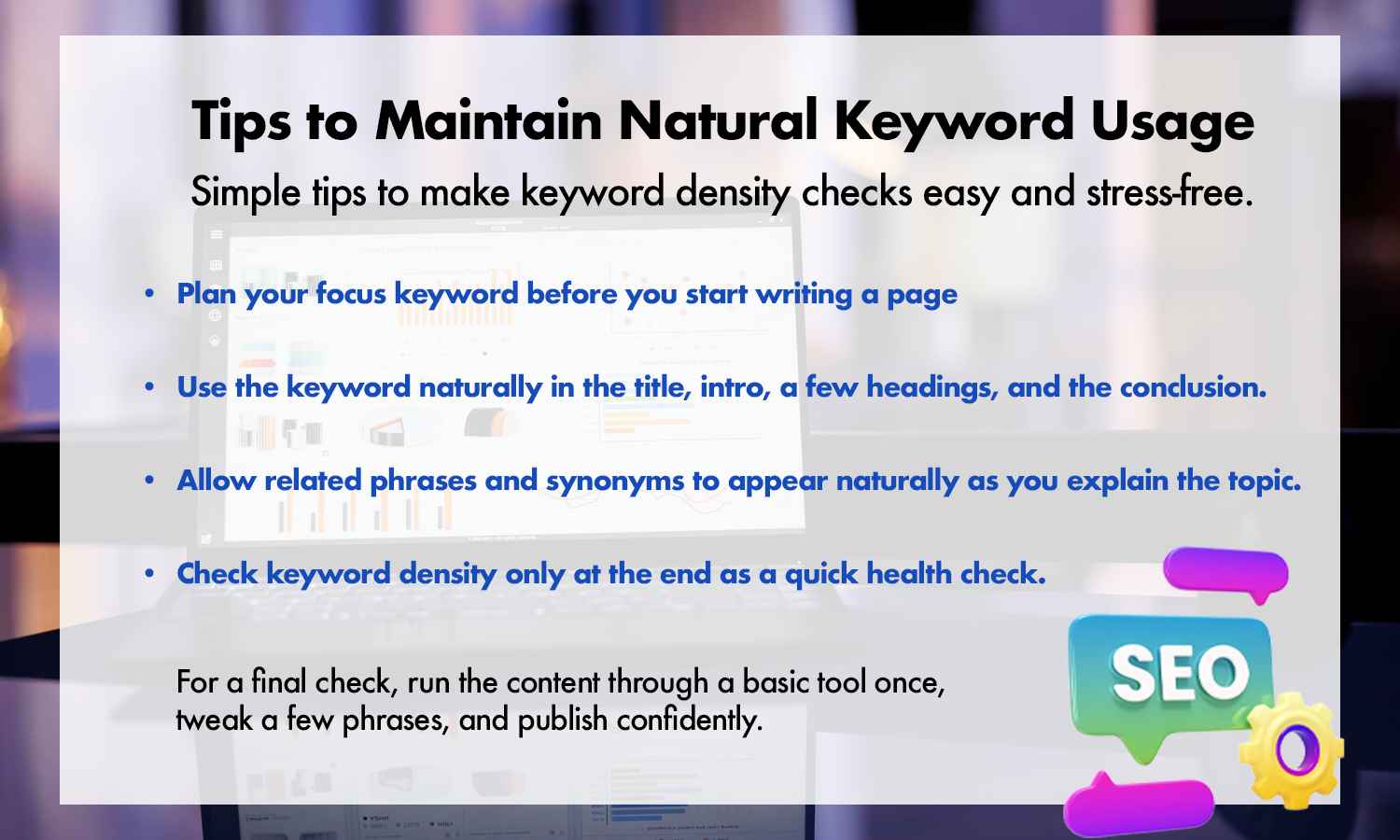
Here are a few practical tips that make Checking Keyword Density feel normal and light instead of stressful:
- Plan your focus keyword before you start writing a page
- Use that keyword in natural spots like the title, introduction, one or two headings, and the closing section
- Let related phrases and synonyms appear on their own as you explain the topic fully
- Only check density at the end as a quick health check, not after every paragraph
If you want a final safety check, you can run the content through a basic tool once, adjust a few phrases, and then publish with confidence.